
Intolerance (1916)

Robert Harron and Mae Marsh
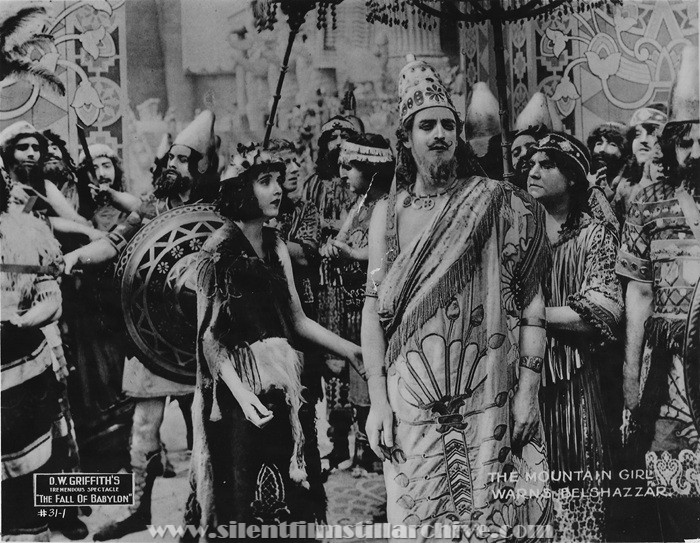
D. W. GRIFFITH'S
TREMENDOUS SPECTACLE
"THE FALL OF BABYLON"
The Mountain Girl Warns Belshazzar
#31-1 Constance Talmadge and Alfred Paget
In 1919 director D. W. Griffith removed the Babylonian story from INTOLERANCE and added more footage that had already been shot and released it as a stand-along feature to recoup some of his losses from INTOLERANCE.
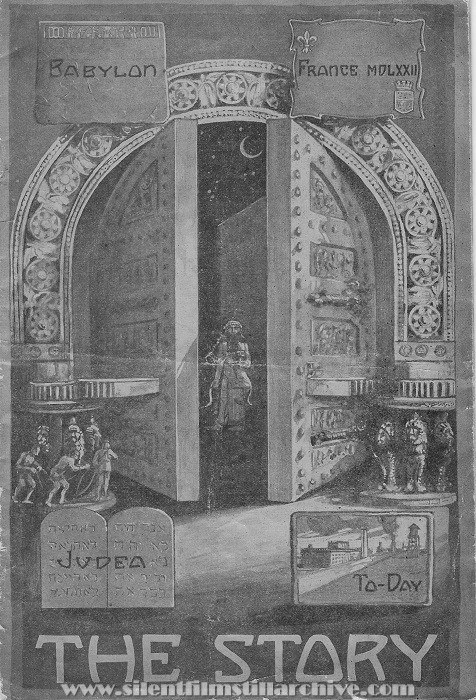
BABYLON FRANCE MDLXXII
JUDEA
TO-DAY
THE STORY
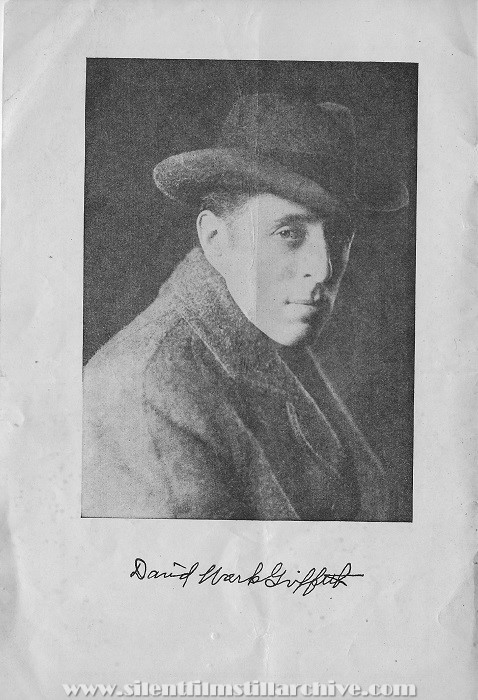
David Wark Griffith
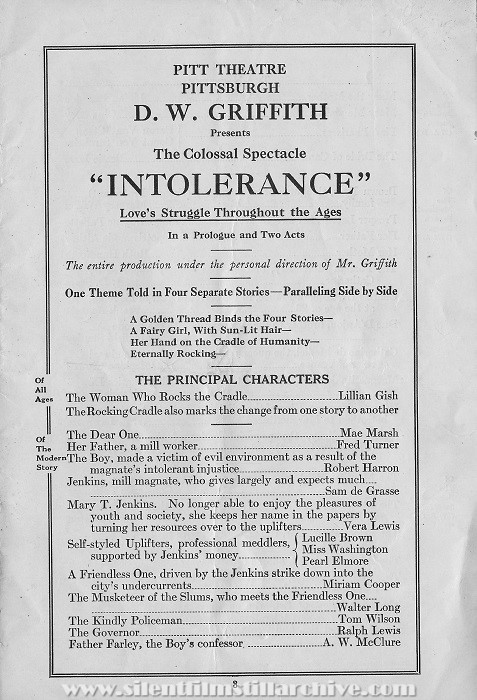
PITT THEATRE
PITTSBURG
D. W. GRIFFITH
Presents
The Colossal Spectacle
"INTOLERANCE"
Love's Struggle Throughout the Ages
In a Prologue and Two Acts
The entire production under the personal direction of Mr. Griffith.
One Theme Told in Four Separate Stories -- Paralleling Side By Side
A Golden Thread Binds the Four Stories --
A Fairy Girl,
With Sun-Lit Hair --
Her Hand on the Cradle of Humanity --
Eternally Rocking --
THE PRINCIPAL CHARACTERS
Of All Ages
| The Woman Who Rocks the Cradle | Lillian Gish |
The Rocking Cradle also marks the change from one story to another.
Of The Modern Story
| The Dear One | Mae Marsh |
| Her Father, a mill worker | Fred Turner |
| The Boy, made a victim of evil environment as a result of the magnate's intolerant injustice | Robert Harron |
| Jenkins, mill magnate, who gives largely and expects much | Sam de Grasse |
| Mary T. Jenkins. No longer able to enjoy the pleasures of youth and society, she keeps her name in the papers by turning her resources over to the uplifters | Vera Lewis |
| Self-styled Uplifters, professional meddlers, supported by Jenkin's money | Lucille Brown Miss Washington Pearl Elmore |
| A Friendless One, driven by the Jenkins strike down into the city's undercurrents | Miriam Cooper |
| The Musketeer of the Slums, who meets the Friendless One | Walter Long |
| The Kindly Policeman | Tom Wilson |
| The Governor | Ralph Lewis |
| Father Farley, the Boy's confessor | A. W. McClure |
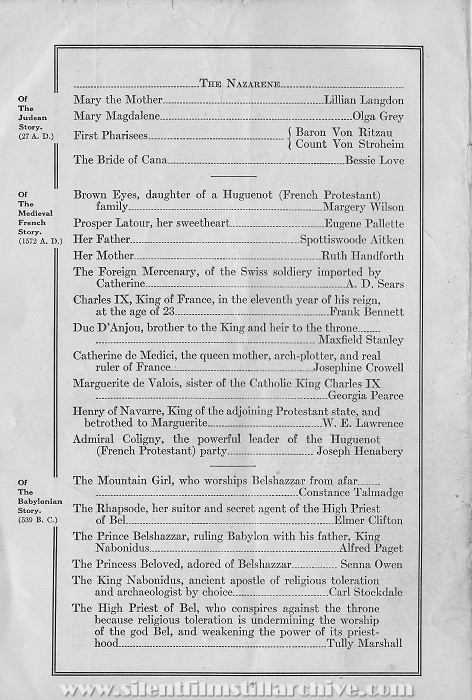
Of The Judean Story. (27 A.D.)
| THE NAZARENE | (Howard Gaye) |
| Mary the Mother | Lillian Langdon |
| Mary Magdalene | Olga Grey |
| First Pharisees | Baron Von Ritzau Count (Erich) Von Stroheim |
Of the Medieval French Story (1572 A. D.)
| Brown Eyes, daughter of a Huguenot (French Protestant) family | Margery Wilson |
| Prosper Latour, her sweetheart | Eugene Pallette |
| Her Father | Spottiswoode Aitken |
| Her Mother | Ruth Handforth |
| The Foreign Mercenary, of the Swiss soldiery imported by Catherine | A. D. Sears |
| Charles IX, King of France, in the eleventh year of his reign, at the age of 23 | Frank Bennett |
| Duc D'Anjou, brother to the King and heir to the throne | Maxfield Stanley |
| Catherine de Medici, the queen mother, arch-plotter, and real ruler of France | Josephine Crowell |
| Marguerite de Valois, sister of the Catholic King Charles IX | Georgia Pearce Constance Talmadge |
| Henry Navarre, King of the adjoining Protestant state, and betrothed to Marguerite | W. E. Lawrence |
| Adminal Coligny, the powerful leader of the Huguenot (French Protestant) party | Joseph Henabery |
Of the Babylonian Story (539 B.C.)
| The Mountain Girl, who worships Belshazzar from afar | Constance Talmadge |
| The Rhapsode, her suitor and secret agent of the High Priest | Elmer Clifton |
| The Prince Belshazzar, ruling Babylon with his father, King Nabonidus | Alfred Paget |
| The Princess Beloved, adored of Belshazzar | Seena Owen |
| The King Nabonidus, ancient apostle of religious toleration and archaeologist by choice | Carl Stockdale |
| The High Priest of Bel, who conspires against the throne because religious toleration is undermining the worship of the god Bel, and weakening the power of its priesthood | Tully Marshall |
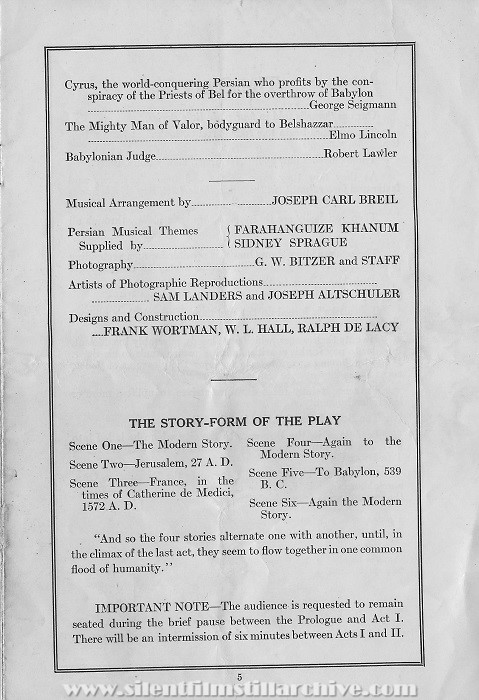
| Cyrus, the world-conquering Persian who profits by the conspiracy of the Priests of Bel for the overflow of Babylon | George Seigmann |
| The Mighty Man of Valor, bodyguard to Belshazzar | Elmo Lincoln |
| Babylonian Judge | Robert Lawler |
__________
| Musical Arrangement by | JOSEPH CARL BREIL |
| Persian Musical Themes Supplied by | FARAHANGUIZE KHANUM SIDNEY SPRAGUE |
| Photography | G. W. BITZER and STAFF |
| Artists of Photographic Reproductions | SAM LANDERS and JOSEPH ALTSCHULER |
| Designs and Consultation | FRANK WORTMAN, W. L. HALL, RALPH DE LACY |
__________
THE STORY-FORM OF THE PLAY
Scene One -- The Modern Story.
Scene Two -- Jerusalem, 27 A. D.
Scene Three -- France, in the times of Catherine de Medici, 1572 A. D.
Scene Four -- Again to the Modern Story
Scene Five -- To Babylon, 539 B. C.
Scene Six -- Again the Modern Story.
"And so the four stories alternate one with another, until, in the climax of the last act, they seem to flow together in one common flood of humanity."
IMPORTANT NOTE -- The audience is requested to remain seated during the brief pause between the Prologue and Act I. There will be an intermission of six minutes between Acts I and II.
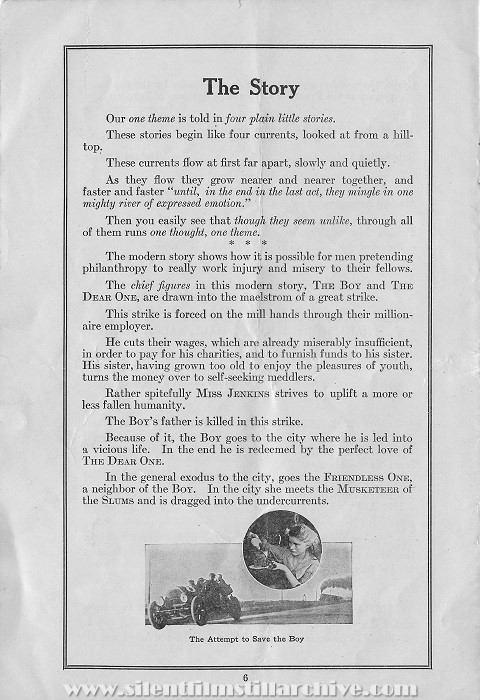
THE STORY
Our one theme is told in four plain little stories.
These stories begin like four currents, looked at from a hill-top.
These currents flow at first far apart, slowly and quietly.
As they flow they grow nearer and nearer together, and faster and faster "until, in the end of the last act, they mingle in one mighty river of expressed emotion."
Then you easily see that though they seem unlike, through tall of them runs one thought, one theme.
* * *
The modern story shows how it is possible for men pretending philanthropy to really work injury and misery to their fellows.
The chief figures in this modern story, THE BOY and THE DEAR ONE, are drawn into the maelstrom of a great strike.
This strike is forced on the mill hands through their millionaire employer.
He cuts their wages, which are already miserably insufficient, in order to pay for his charities, and to furnish funds to his sister. His sister, having frown too old to enjoy the pleasures of youth, turns the money over to self-seeking meddlers.
Rather spitefully MISS JENKINS strives to uplift a more or less fallen humanity.
The BOY's father is killed in this strike.
Beacuse of it, the BOY goes to the city where he is led into a vicious life. In the end he is redeemed by the perfect love of THE DEAR ONE.
In the general exodus to the city, goes the FRIENDLESS ONE, a neighbor of the BOY. In the city she meets the MUSKETEER of the SLUMS and is dragged into the undercurrents.
The Attempt to Save the Boy
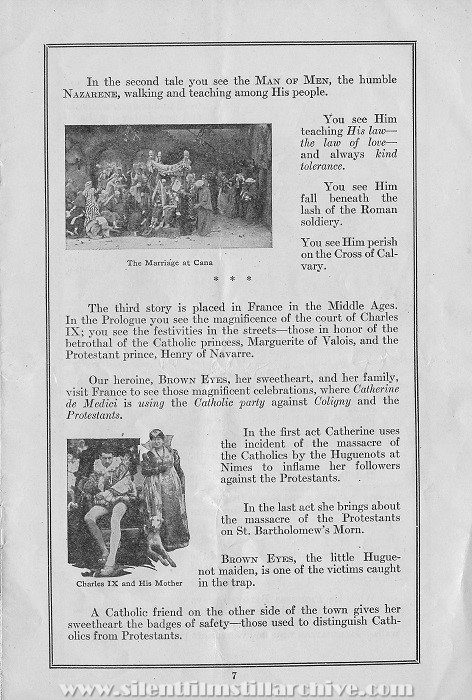
In the second tale you see the MAN OF MEN, the humble NAZARENE, walking and teaching among His people.
You see Him teaching His law -- the law of love -- and always kind tolerance.
You see Him fall beneath the lash of the Roman soldiery.
You see Him perish on the Cross of Calvary.
The Marriage at Cana.
The third story is placed in France in the Middle Ages. In the Prologue you see the magnificence of the court of Charles IX; you see the festivities in the streets -- those in honor of the betrothal of the Catholic princess, Marguerite of Valois, and the Protestant prince, Henry of Navarre.
Our heroine, BROWN EYES, her sweetheart, and her family, visit France to see those magnificent celebrations, where Catherine de Medici is using the Catholic party against Coligny and the Protestants.
In the first act Catherine uses the incident of the massacre of the Catholics by the Huguenots at Nimes to inflame her followers against the Protestants.
In the last act she brings about the massacre of the Protestants of St. Bartholomew's Morn.
BROWN EYES, the little Huguenot maiden, is one of the victims caught in the trap.
A Catholic friend on the other side of the town gives her sweetheart the badges of safety -- those used to distinguish Catholics from Protestants.
Charles IX and His Mother
Her lover rushes wildly through the mad streets in an attempt to save her with the password and badges, while she and her father are barricaded in their little home.
The fourth story is placed in Babylon, at the time BELSHAZZAR, the Golden Prince, was ruling for his father Nabonidus.
Nabonidus was a lover of peace and religious toleration.
On this account he welcomed the worship of Ishtar, the Love Goddess.
This aroused the antagonism of the intolerant high priest of Bel.
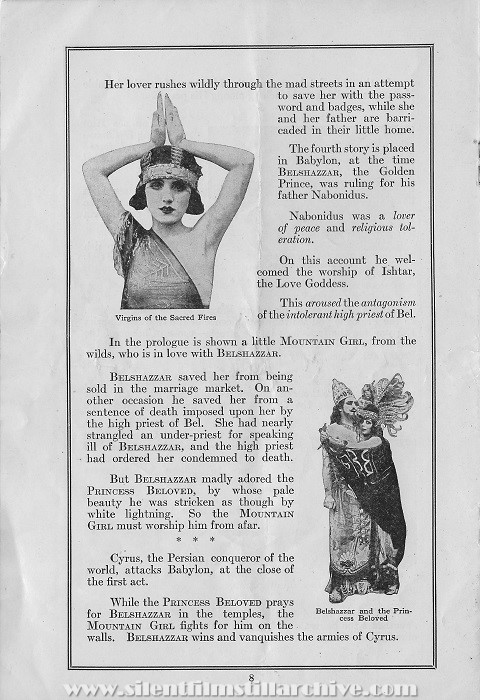
Virgins of the Sacred Fires
In the prologue is shown a little MOUNTAIN GIRL, from the wilds, who is in love with BELSHAZZAR.
BELSHAZZAR saver her from being sold in the marriage market. On another occasion he saved her from a sentence of death imposed upon her by the high priest of Bel. She had nearly strangled an under-priest for speaking ill of BELSHAZZAR, and the high priest had ordered her condemned to death.
But BELSHAZZAR madly adored the PRINCESS BELOVED, by whose pale beauty he was stricken as though by white lightning. So the MOUNTAIN GIRL must worship him from afar.
* * *
Cyrus, the Persian conqueror of the world, attacks Babylon, at the close of the first act.
While the PRINCESS BELOVED prays for BELSHAZZAR in the temples, the MOUNTAIN GIRL fights for him on the walls. BELSHAZZAR wins and vanquishes the armies of Cyrus.
Belshazzar and the Princess Beloved
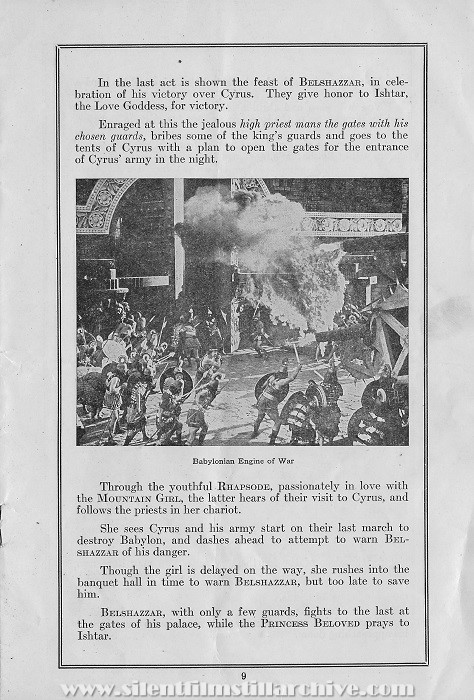
In the last act is shown the feast of BELSHAZZAR, in celebration of his victory of Cyrus. They give honor to Ishtar, the Love Goddess, for victory.
Enraged at this the jealous high priest mans the gates with is chosen guards, bribes some of the king's guards and goes to the tents of Cyrus witha plan to open the gates for the entrance of Cyrus' army in the night.
Babylonian Engine of War
Through the youthful RHAPSODE, passionately in love with the MOUNTAIN GIRL, the latter hears of the visit to Cyrus, and follow the priests in her chariot.
She sees Cyrus and his army start on their last march to destroy Babylon, and dashes ahead to attempt to warn BELSHAZZAR of his danger.
Though the girl is delayed on the way, she rushes into the banquet hall in time to warn BELSHAZZAR, but too late to save him.
BELSHAZZAR, with only a few guards, fights to the last at the gates of his palace, while the PRINCESS BELOVED prays to Ishtar.
You will see her splendor destroyed by Cyrus and his hordes.
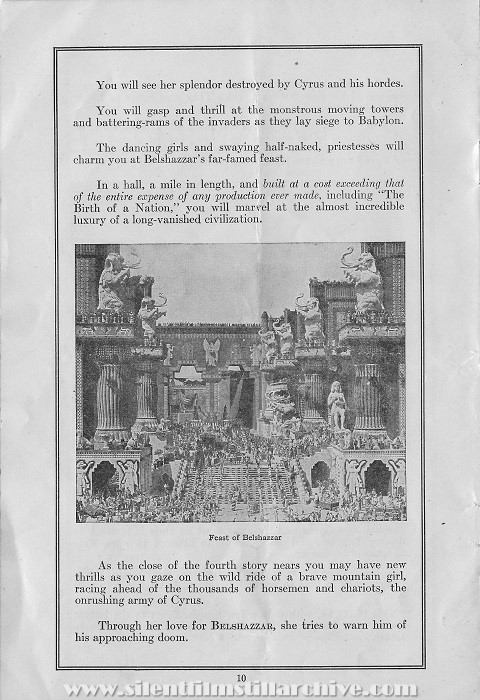
You will gasp and thrill at the monstrous moving towers and battering-rams of the invaders as they lay siege to Babylon.
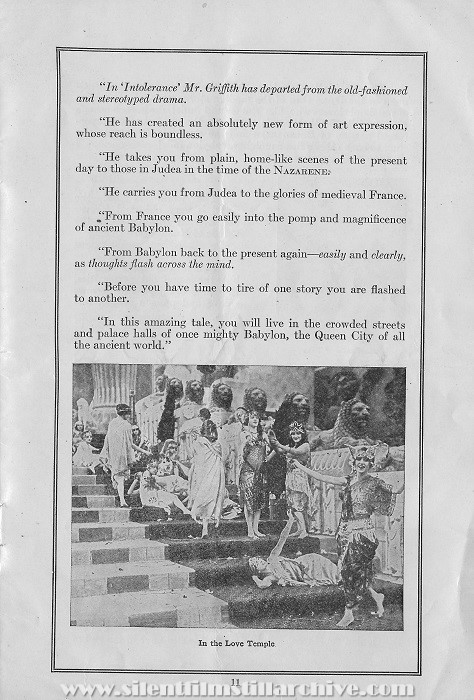
The dancing girls and swaying half-naked, priestesses will charm you at Belshazzar's far-famed feast.
In a hall, a mile in length, and built at a cost exceed that of the entire expense of any production ever made, including "The Birth of a Nation," you will marvel at the almost incredible luxury of a long-vanished civilization.
Feast of Belshazzar.
As the close of the fourth story nears you may have new thrills as you gaze on the wild ride of a brave mountain girl, racing ahead of the thousands of horsemen and chariots, the onrushing army of Cyrus.
Through her love for BELSHAZZAR, she tries to warn him of his approaching doom.
"In 'Intolerance' Mr. Griffith has departed from the old-fashioned and stereotyped drama.
"He has created an absolutely new form of art expression, whose reach is boundless.
"He takes you from the plain, home-like scenes of the present day to those in Judea in the time of the NAZARENE:
"He carries you from Judea to the glories of medieval France.
"From France you go easily into the pomp and magnificence of ancient Babylon.
"From Babylon back to the present again -- easily and clearly, as thoughts flash across the mind.
"Before you have time to tire of one story you are flashed to another.
"In this amazing tale, you will live in the crowded streets and palace halls of once mighty Babylon, the Queen City of all the ancient world."
In the Love Temple
Through it all moves love -- from the tender, redeeming sentiment of the DEAR ONE of the modern story -- through the hearts of the simple lovers who, like Romeo and Juliet, die in each other's arms on St. Bartholomew's morn, to the wild, barbaric, perfumed passion of BELSHAZZAR and the PRINCESS BELOVED, who cling to each other's lips as mighty Babylon falls!
__________
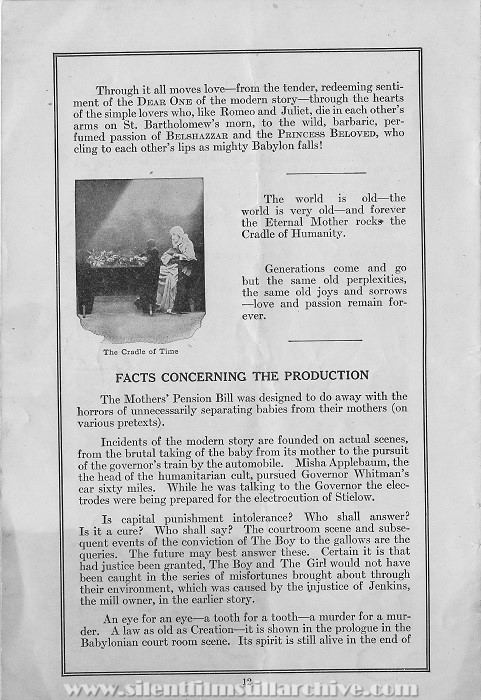
The world is old -- the world is very old -- and forever the Eternal Mother rocks the Cradle of Humanity.
Generations come and go but the same old perplexities, the same old joys and sorrows -- love and passion remain forever.
The Cradle of Time
__________
FACTS CONCERNING THE PRODUCTION
The Mothers' Pension Bill was designed to do way with the horrors of unnecessarily separating babies from their mothers (on various pretexts).
Incidents of the modern story are founded on actual scenes, from the brutal taking of the baby from its mother to the pursuit of the governor's train by the automobile. Misha Applebaum, the head of the humanitarian cult, pursued Governor Whitman's car sixty miles. While he was talking to the Governor the electrodes were being prepared for the electrocution of Stielow.
Is capital punishment intolerance? Who shall answer? It is a cure? Who shall say? The courtroom scene and the subsequent events of the convition of The Boy to the gallows are the queries. The future may best answer these. Certain it is that had justice been granted, The Boy and The Girl would not have been caught in the series of misfortunes brought about through their environments, which was caused by the injustice of Jenkins, the mill owner, in the earlier story.
An eye for an eye -- a tooth for a tooth -- a murder for a murder. A law as old as Creation -- it is shown in the prologue in the Babylonian court room scene. Its spirit is still alive in the end of
the first act. Catherine uses the thought: an eye for an eye, a tooth for a tooth, a murder for a murder, in inflaming the minds of the Catholics against the Protestants. Its spirit is repeated again in the last act, in the modern court room where The Boy is sentenced to death for murder (in this case one he did not commit). Have we, as a group, any more right, through the workings of law, to murder a murderer than the murderer himself had to commit this crime? The bell tolling in the last act during the scene of the massacre of St. Bartholomew symbolizes the tolling of the bell of St. Germain which actually boomed over Paris on that fateful day.
__________
The latest excavations in Mesopotamia have unearthed cuneiform tablets which tell the true story of the Fall of Babylon. The intolerant treachery of the priests brought about the victgory of Cyrus as shown in "Intolerance."
__________
Contrary to belief, the Babylonians, being very religious, watered the ground with their tears of penitence and also prayed earnestly before going into battle.
__________
The musical sources of the production embrace widely varied themes, from the "Hymn of Apollo," the most ancient melody preserved and one that was possibly sung in the days of Babylon, down through the first operatic forms in the days of Catherine de Medici, to the great classic masters since the 17th century, and even to the ballads of the Francois Villons of our asphalt streets. In the scene of The Dear One with "the hopeful geranium," in the Prologue, when the immortal ballad, "Believe Me if All Those Endearing Young Charms," -- The Dear One's theme -- is used:
"The heart that has truly loved never forgets,
But as truly loves on the close.
As the sunflower turns to her god when
he sets
The same look which she turned when he rose."
(The rest of this page is torn and missing.)
Many of the suits of armor used in the battle scenes, though not so ostentatious, were equally expensive as the more ornate costumes, notably the armor worn by Cyrus in battle, which is gold-plated throughout and weighs sixty pounds.
__________
ARE THESE INTOLERANT?
"If we would not be marplots with our miserable interferences, the work, the society, letters, arts, science, religion of men would go on far better than now, and the heaven predicted from the beginning of the world, and still predicted from the bottom of the heart, would organize itself, as do now the rose and the air and the sun." RALPH WALDO EMERSON
HYSTERICAN REFORM
"No age will take hysterical
freform. It will be a bad day for society when sentimentalists are encouraged
to suggest all the measures that shall be taken for the betterment of the
race, and the mind that is impatient, or intolerant, or hoodwinked, or shut
into a petty view, shall have no part in carrying them forward to a true
hospitality." Woodrow Wilson "On Being Human"
A SOCIAL QUESTION
"In the present heated state
of public opinion about the drink situation he who attempts to differentiate
the chaff of exaggeration from the known truth, in writing of its social
aspects, must expect to be stigmatized as an advocate of drink."
JOHN KOREN, in the Atlantic Monthly.
PERILOUS PHILANTHROPY
"From the knowledge I have
gained in my work as Chairman of the Federal Commission of Industrial Relations,
I challenge the wisdom of giving public sanction and approval to the spending
of a huge fortune through such philanthropies as foundations... taking money
obtained from the toil of thousands of poorly nourished, socially submerged
men, women and children, and spending these sums through a board of personal
employees, in
(The rest of this page is torn and missing.)
FROM ANOTHER AGE
Shall man be a free agent in prohibition? It is a grave and serious question. A famous rabbi has said, "While excess and intempeance are most strongly condemned, merely the use of wine is not frowned upon in the Bible."
"And John came among you, neither eating nor drinking, and ye said he was possessed of the devil: Jesus, the Son of Man, came amoung you, both eating and drinking, and ye said --
"A wine bibber, a friend of publicans and sinners." Matthew XI-19.
"Be ye no longer a drinker of water, but use a little wind for the stomach's sake and thine often infirmities," I Timothy V-23
"Wine cheereth God and Man." Judges LX-13.
"Our people have been wine drinkers for thousands of years, and yet are perhaps the most temperate people in existence today."
EARLY CIVILIZATION -- Babylon
(Added note to Herodotus by the Editor, George Rawlinson.)
For nearly two thousand years Babylon was the center of the world's civilization.
Her script and her language were known in Egypt, and on the shores of the
Mediterranean, and were the universal medium of communication between educated
men. She was the bank and emporium of the East, and in the age of her splendor,
with her daughter states about her dominated the thoughts of mankind. What
Rome has been, and London is, that Babylon was -- "the glory of the
kingdoms, the beauty of the Chaldean's pride" (Isaiah XIII-7). Her
ruins are still wonderful; but she has left us spiritual ruins, too, and
these are yet more strange. The debt of ancient Israel to Babylon was immense.
The code of Hammurabi (B. C. 2200) may well have influenced the Mosaic code;
the angelology of later Jewish Scriptures was Babylonian in origin; the
legends of Creation, the Fall, and the Deluge, are of Babylon ancestry.
Little wonder if, when the end came, and she fell, a cry went through the
earth that had once feared her power, her pride, her universal empire -- "Babylon
is fallen, is fallen!" (Isaiah XXI-9.)
AUTHORITIES
(The rest of this page is torn and missing.)
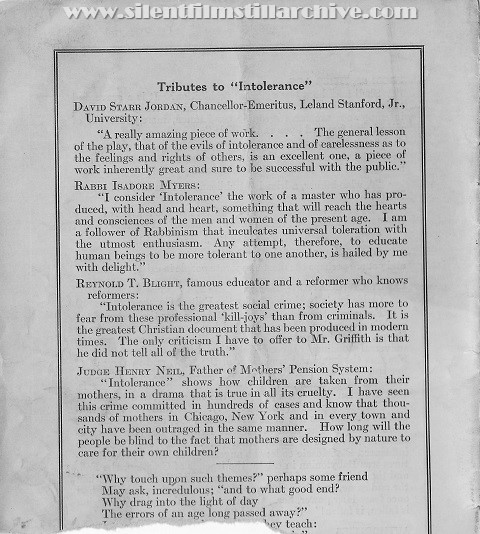
Tributes to "Intolerance"
DAVID STARR JORDAN, Chancellor-Emeritus, Leland Standord, Jr., University:
"A really amazing piece of work.... The general lesson of the play, the evils of intolerance and of carelessness as to the feelings and rights of others, is an excellent one, a piece of work inherently great and sure to be successful with the public."
RABBI ISADORE MYERS:
"I consider 'Intolerance' the work of a master who has produced, with head and heart, something that will reach the hearts and consciences of the men and women of the present age. I am a follower of Rabbinism that inculcates universal toleration with the utmost enthusiasm. Any attempt, therefore, to educate human beings to be more tolerant to one another, is hailed by me with delight."
REYNOLD T. BLIGHT, famous educator and reformer who knows reformers:
"Intolerance is the greatest social crime; society has more to fear from these professional 'kill-joys' than from criminals. It is the greatest Christian document that has been produced in modern times. The only criticism I have to offer to Mr. Griffith is that he did not tell all of the truth.
JUDGE HENRY NEIL, Father of Mother's Pension System:
"Intolerance"
shows how children are taken from their mothers, in a drama that is true
in all its cruelty. I have seen this crime committed in hundreds of cases
and know that thousands of mothers in Chicago, New York and in every town
and city have been outraged in the same manner. How long will the people
be blind to the fact that mothers are designed by nature to care for their
own children?
__________
"Why touch upon such themes?" perhaps some friend
May ask, incredulous; "and to what good end?
Why drag into the light
of day
The errors of an age long passed away?"
(The rest of this page is torn and missing.)
With Lillian Gish, Mae Marsh, Robert Harron, and Constance Talmadge. Directed by D. W. Griffith. Wark/Triangle.
More Information on this Film






This work (Intolerance (1916), by
Wark/Triangle), identified by
Bruce Calvert, is free of known copyright restrictions.
Books
None