
The Dancing Girl (1915)
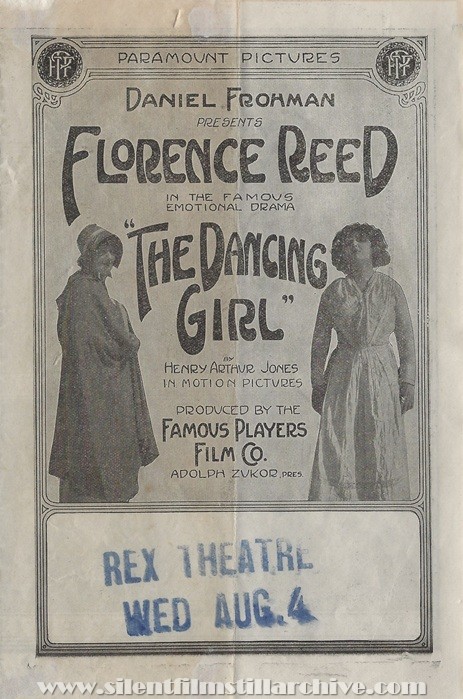
PARAMOUNT PICTURES
DANIEL FROHMAN
Presents
FLORENCE REED in the famous emotional drama
"THE DANCING GIRL"
by
HENRY ARTHUR JONES
IN MOTION PICTURES
PRODUCED BY THE FAMOUS PLAYERS FILM CO.
ADOLPH ZUKOR, Pres.
REX THEATRE
WED AUG.4 (1915)
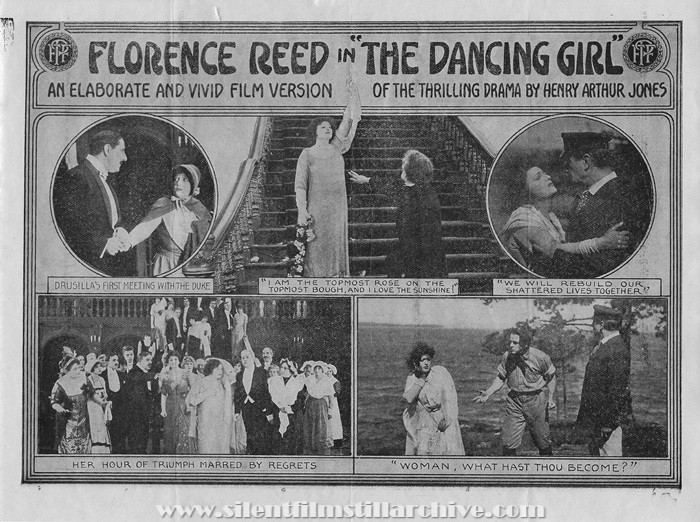
FLORENCE REED in "THE DANCING GIRL"
AN ELABORATE AND VIVID FILM VERSION OF THE THRILLING DRAMA BY HENRY ARTHUR JONES
DRUSILLA'S FIRST MEETING WITH THE DUKE
"I AM THE TOPMOST ROSE ON THE TOPMOST BOUGH, AND I LOVE THE SUNSHINE!"
"WE WILL REBUILD OUR SHATTERED LIVES TOGETHER"
HER HOUR OF TRIUMPH MARRED BY REGRETS
"WOMAN, WHAT HAST THOU BECOME?"

FLORENCE REED
in
"THE DANCING GIRL"
IN MOTION PICTURES
CAST OF CHARACTERS.
| DRUSILLA IVES | FLORENCE REED |
| David Ives | Fuller Mellish |
| Faith Ives | Lorraine Huling |
| A Quaker | Malcolm Williams |
| John Christison | William Russell |
| Duke of Guiseberry | Eugene Ormonde |
| Mr. Crake (his overseer) | William Lloyd |
| Lady Bawtry (the duke's aunt) | Minna Gale |
REVIEW
FLORENCE REED, the celebrated emotional actress, whose amazing talents have been seen to advantage in such noted Broadway successes as "Seven Days," "The Typhoon," and "The Yellow Ticket," in the last of which she won a distinct personal triumph, makes her first appearance in motion pictures in the Famous Players Film Company's realistic and artistic screen adaptation of Henry Arthur Jonesapos; world-famous drama, "The Dancing Girl."
The mobile features and pantomimic power of this talented young American star lead themselves readily to the screen, and her grace and beauty of rom not only render Miss Reed particularly suited to the role of "The Dancing Girl," but make her a welcome and valuable addition to the photoplay world.
"The Dancing Girl" might have been written for the camera, so full of action and picturesqueness is every scene, the colorful exteriors of the rocky coast of the "Isle of Endellion" contrasting with the rich interiors of the elegant home of the profilgate Duke of Guiseberry, under whose patronage the dancing girl lives for a time; and there is the dramatic comparison of the sober life of the grave Quakers on the lonely island with the gay life of London society and the bright Bohemia of the singers and artists, with whom the Quaker girl, Drusilla, mingles when she becomes the favorite of the Duke. Perhaps the greatest incident of the play is the famous "staircase scene," where Drusilla, at the zenith of her fame, having come to dance before the Duke's own family, declares to her amazed and angry old Quaker father, who comes in search of her, that she wants to be "the topmost rose on the topmost bough, and live in the sunshine,&auot and is crushed by the terrible wrath of a father's curse. Tottering for a moment beneath her father's scourging censure, she faints, and falls the length of the grand staircase, and awakes to consciousness, knowing at last the havoc she has made of her life and the shame she is to her people. The tragedy of this is followed by the splendid scene in which occurs the meeting of penitent Drusilla with the nobleman whom her extravagance has ruined, on the lonely coast of Endellion, where both have come to seek death, and where they decide, instead, to rebuild their shattered lives and to share a newer, purer life.
With Florence Reed and Fuller Mellish. Directed by Allan Dwan. Paramount.
More Information on this Film






This work (The Dancing Girl (1915), by Paramount), identified by Bruce Calvert, is free of known copyright restrictions.
Books
None